Meritocracy and Redistributive Preferences at School Level in Chile


Juan Carlos Castillo, Kevin Carrasco & Andreas Laffert

FONDECYT No. 1210847 “Meritocracy at school: Moral foundations of educational markets and their implications for civic education in Chile”

5th ISA Forum of Sociology

Friday, 11 July 2025

Final conclusions

  • The perception of non-meritocracy negatively influences preferences for market justice

  • The preference for non-meritocratic factors positively influences preferences for market justice

  • talent as the threatening component of meritocracy

Some context

Research projects

  • 2016-2020: The moral economy of meritocracy and redistributive preferences. Castillo, JC., Atria, J. & Maldonado, L.
  • 2021-2025: Meritocracy at school: Moral foundations of educational markets and its consequences for citizenship education in Chile. Castillo, JC., Moyano, C., Angelcos, N. & Salgado, M.
  • 2025-2028: Market Justice and social welfare deservingness. Castillo, JC.

Meritocracy at school

Our (current) team

JC
Kevin
Andreas
Mafe
Tomás
René

Last works

  • Castillo, J. C., Iturra, J., & Carrasco, K. (2025). Changes in the Justification of Educational Inequalities: The Role of Perceptions of Inequality and Meritocracy During the COVID Pandemic. Social Justice Research. https://doi.org/10.1007/s11211-025-00458-0
  • Moyano Dávila, C., Alarcón-Arcos, S., Angelcos, N., Castillo, J. C., & Salgado, M. (2025). Merit as an Attitude: Chilean School Communities’ Repertoires in Chile and the Perception of the “Good Student” in a Post-pandemic Scenario. Social Justice Research. https://doi.org/10.1007/s11211-025-00456-2
  • Castillo, J. C., Salgado, M., Carrasco, K., & Laffert, A. (2024). The Socialization of Meritocracy and Market Justice Preferences at School. Societies, 14(11), Article 11. https://doi.org/10.3390/soc14110214
  • Carrasco, K., García-Castro, J. D., & Castillo, J.-C. (2024). La socialización de las actitudes hacia la desigualdad y meritocracia en la etapa escolar en chile. In G. Assusa & G. Benza (Eds.), America Latina desigual: Preguntas, enfoques y tendencias actuales. Siglo XXI Editores.
  • Castillo, J.-C., Iturra, J., Maldonado, L., Atria, J., & Meneses, F. (2023). A multidimensional approach for measuring meritocratic beliefs: Advantages, limitations and alternatives to the ISSP social inequality survey. International Journal of Sociology, Online first. https://doi.org/10.1080/00207659.2023.2274712
  • Iturra, J., Castillo, J.-C., Rufs, C., & Maldonado, L. (2023). Percepción de desigualdad económica y su influencia sobre la justificación de las diferencias de ingreso legítimas. Estudios Sociológicos, 4(122). https://doi.org/10.24201/es.2023v41n122.2260

Meritocracy

Meritocracy & inequality beliefs

  • Meritocracy is conceived as a system where rewards are distributed according to individual effort and talent (Young, 1958)

  • Merit = effort + talent (Young, 1958)

  • Associated with the justification of inequality by legitimizing differences often linked to opportunities (Mijs, 2016)

  • Two research strands:

    • stratification and mobility (objective meritocracy)
    • beliefs about meritocracy (subjective meritocracy)

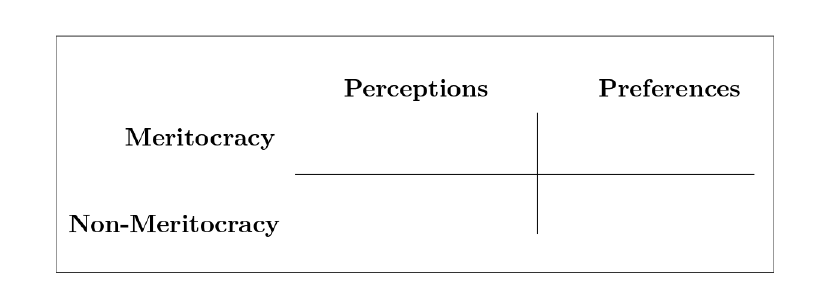
Conceptualizing & measuring meritocratic beliefs (1)

Conceptualizing & measuring meritocratic beliefs (2)

  • Proposed meritocracy conceptual framework and scale by Castillo et al. (2023)

Meritocracy at school

  • School and socialization of meritocratic values

  • Particularly in societies with a high degree of commodification of educational institutions (as Chile)

  • So far, most research on meritocracy has focused on the adult population, neglecting the study of factors associated with these beliefs at earlier ages, as well as their socialization.

Redistribution and Market Justice Preferences

Market justice

  • Who deserves what and why?

  • Despite high income inequality and limited social mobility in Chile, there is a belief that individuals are responsible for their economic outcomes (Salgado & Castillo, 2023; Torche, 2014)

  • Market justice: individuals’ adherence to the allocation of goods and social services (such as health, education, and pensions) according to individuals’ ability to pay (Lane, 1986)

  • Main argument: those who perceive and prefer meritocracy show larger market justice preferences

Research question


To what extent the meritocratic perceptions and beliefs of school-age children are related to market justice preferences?

Data, variables & methods

Data

  • Panel survey “Education and Meritocracy” (EDUMER), conducted in Chile during 2023 and 2024.
  • Students from sixth grade and first year of high school from 9 schools in the Metropolitan Region in CHile.
  • The total number of complete responses is 902 students in wave 1 and 632 in wave 2.

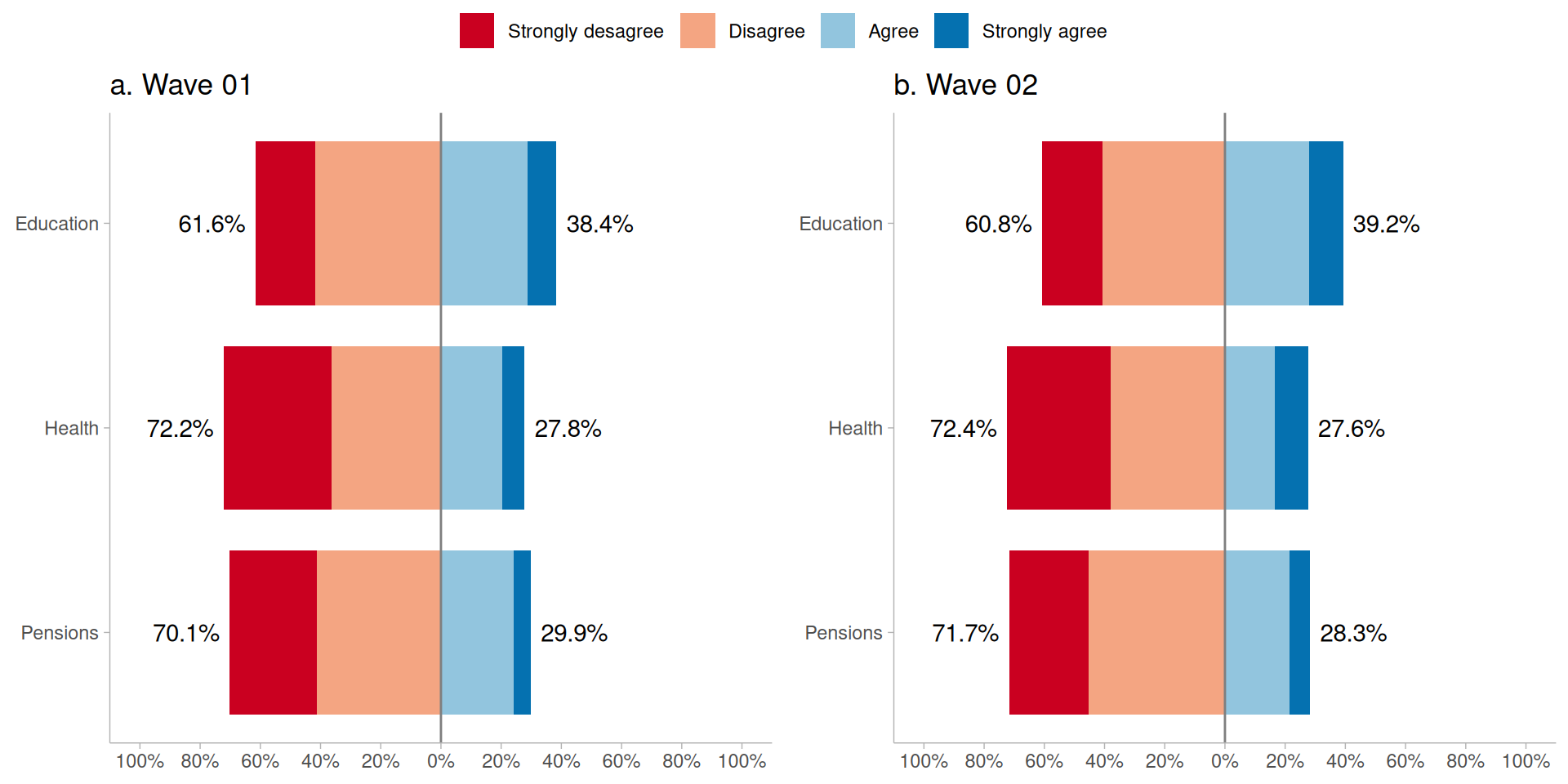
Dependent variable: Market justice

  • Market justice: “It is just that in Chile people with higher incomes can have…”
    • better education
    • better pensions
    • better health access

Market justice preferences

Figure 1

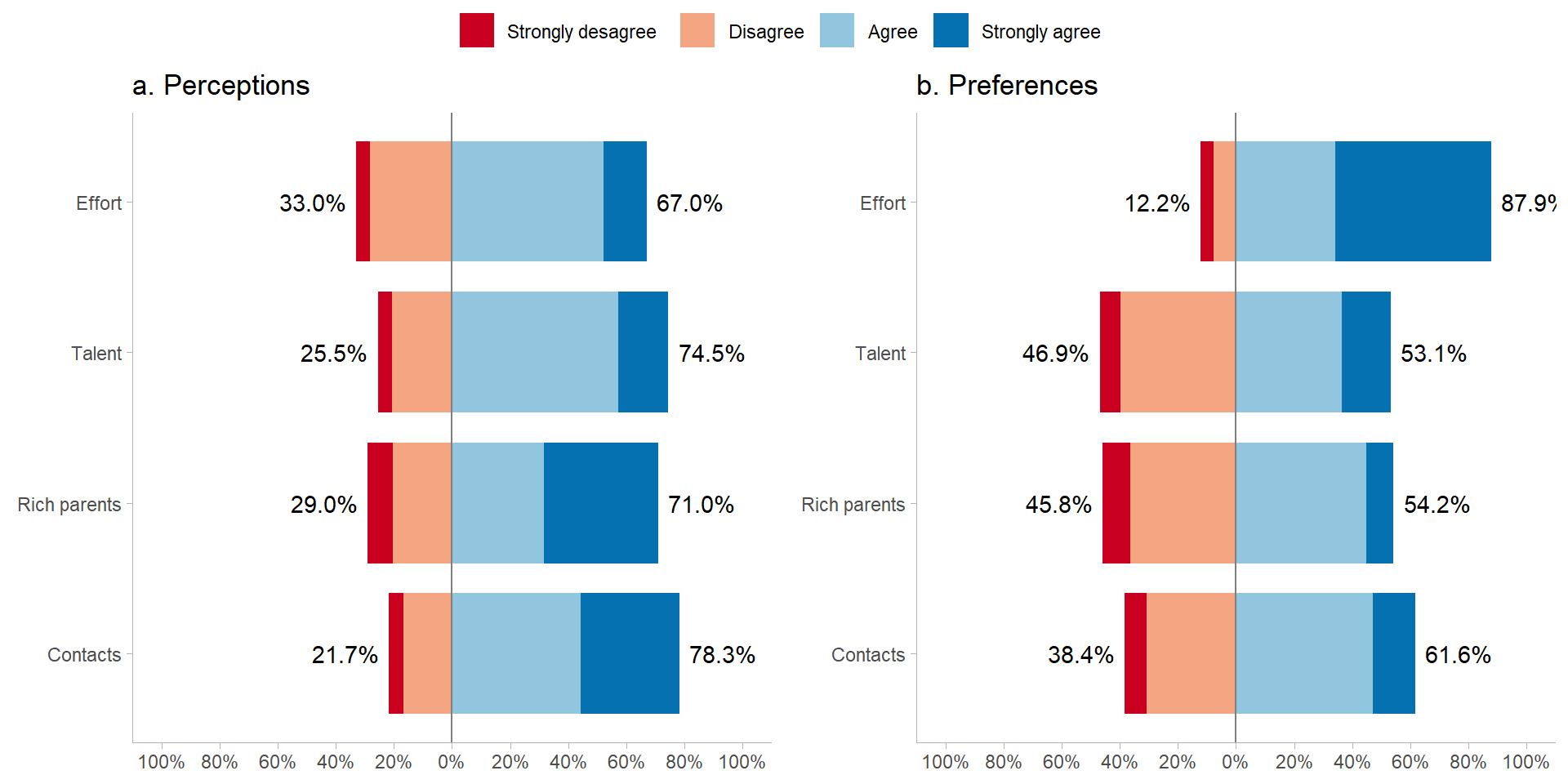
(Main) Independent variable: Meritocracy

Component Dimension Item
Perceptions Meritocratic In Chile, people are rewarded for their efforts
In Chile, people are rewarded for their intelligence and ability
Non-meritocratic In Chile, those with wealthy parents do much better in life
In Chile, those with good connections do better in life
Preferences Meritocratic Those who work harder should get greater rewards than those who work less
Those with more talent should get greater rewards than those with less talent
Non-meritocratic It is acceptable that those with wealthy parents do better in life
It is acceptable that those with good connections do better in life

Meritocracy (Wave 01)

Figure 2

Method

  • First, each variable separately (education, health, and pensions)

  • Estimation of simple mean for the dependent variable preferences for market justice

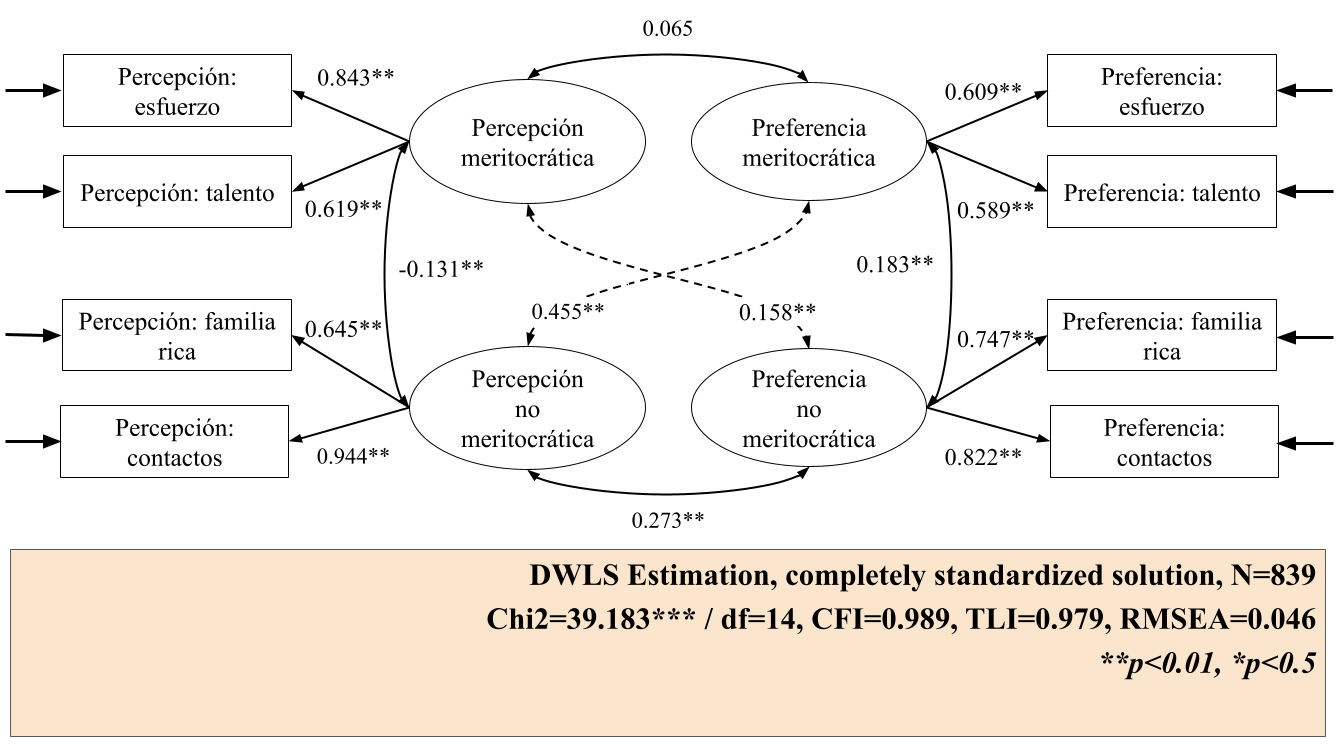
  • Confirmatory factor analysis and estimation of factor scores for the meritocracy scale

  • Longitudinal multilevel model nested within students (627 students)

  • ICC: 0.439

  • Between and Within differences (between students and within students)

  • Controls: age, gender, and cohort

Results

Meritocracy measurement model

Multilevel regresion models

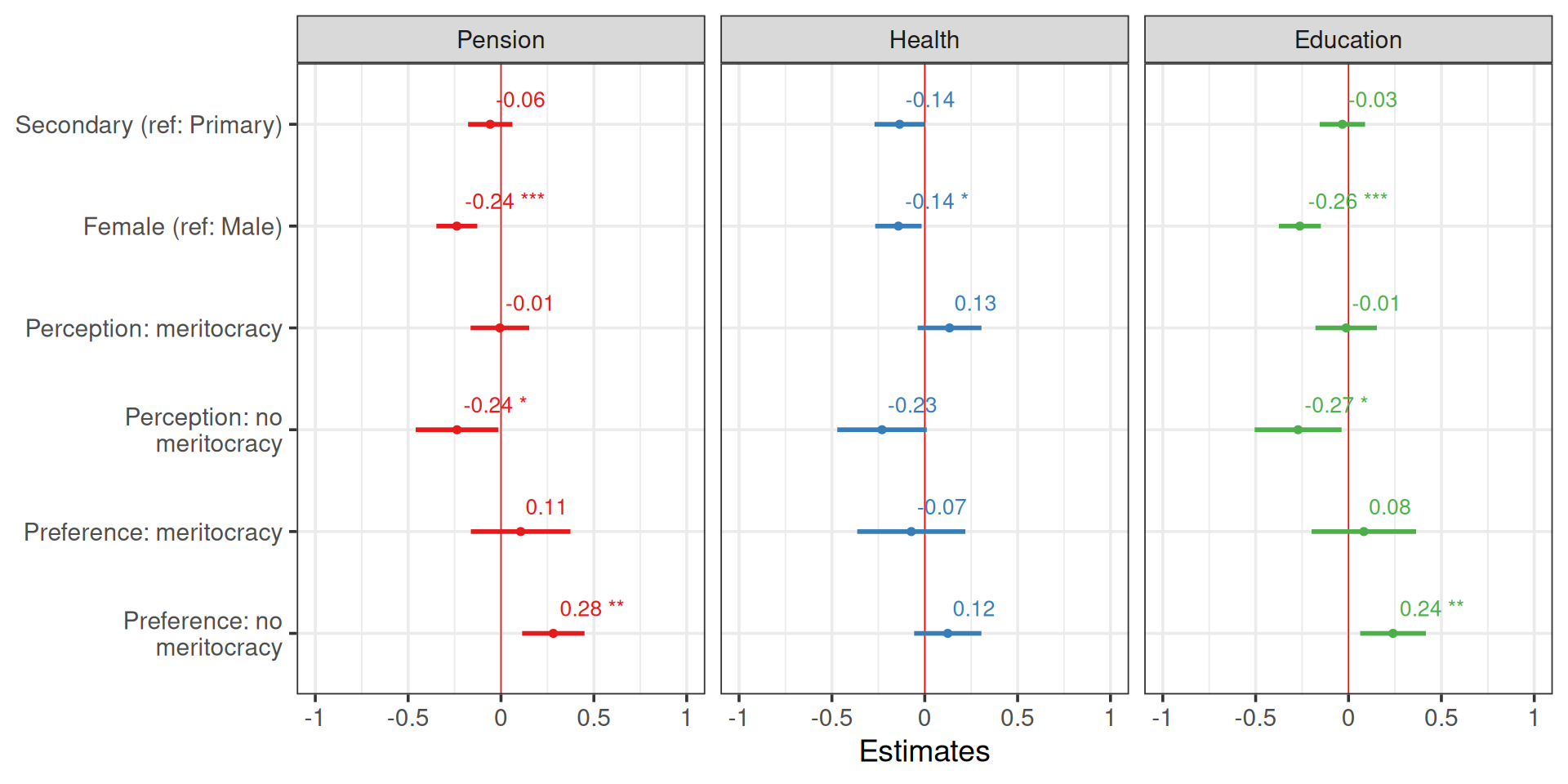
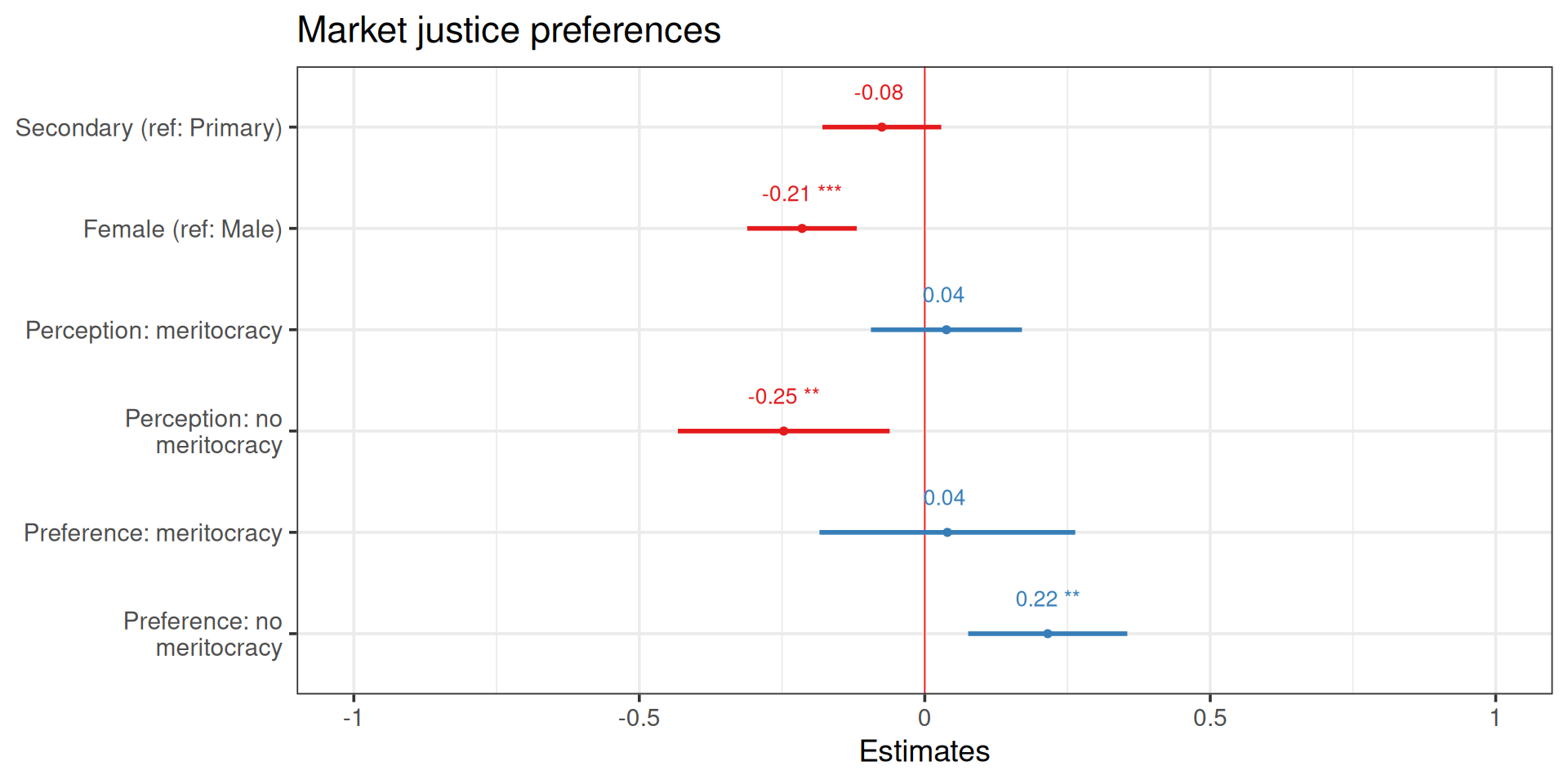
Between Effects

Effects between students

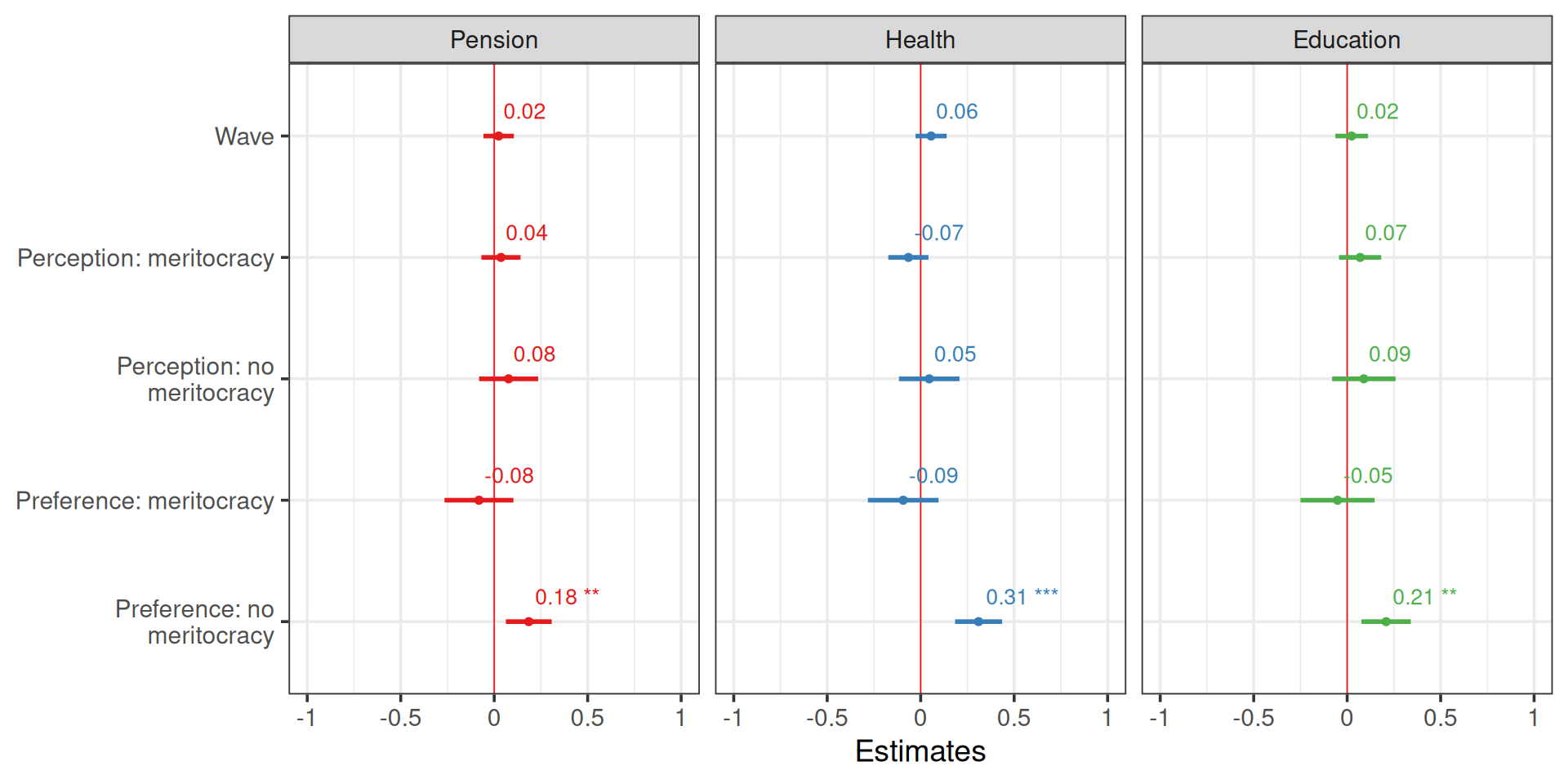
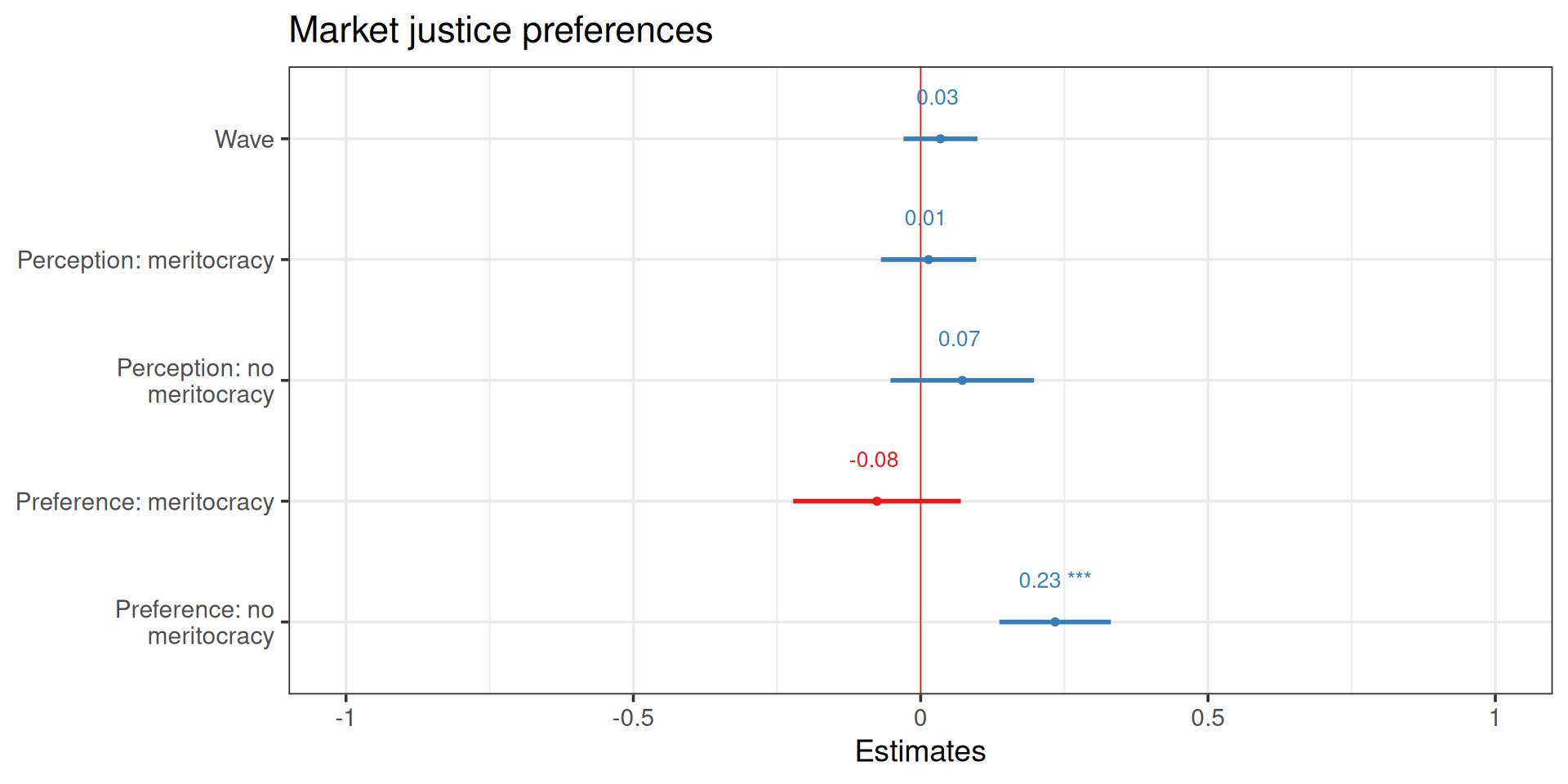
Within Effects

Within-student effects or the effect of change over time

Between Effects

Effects between students

Within Effects

Within-student effects or the effect of change over time

Discussion and Conclusions

Main findings: non-meritocracy

  • The perception of non-meritocracy negatively influences preferences for market justice

  • The preference for non-meritocratic factors positively influences preferences for market justice

  • Few differences over time, only an increase in the preference for non-meritocratic factors positively influences preferences for market justice

Future research

  • focus on non-meritocracy

  • focus on talent

  • typologies / latent class of meritocratic beliefs

  • Include students’ grade point average (justice of rewards)

  • Socioeconomic characteristics of families

Thanks for your attention, and looking forward to your comments!

References

Andersen, D., Lue Kessing, M., & Østergaard, J. (2021). We Have Equal Opportunities – in Theory: Lay Perceptions of Privilege, Meritocracy and Inequality in Denmark. Sociology, 55(6), 1117–1134. https://doi.org/10.1177/0038038521999203
Castillo, J. C., Iturra, J., Maldonado, L., Atria, J., & Meneses, F. (2023). A Multidimensional Approach for Measuring Meritocratic Beliefs: Advantages, Limitations and Alternatives to the ISSP Social Inequality Survey. International Journal of Sociology, 53(6), 448–472. https://doi.org/10.1080/00207659.2023.2274712
Castillo, J. C., Torres, A., Atria, J., & Maldonado, L. (2019). Meritocracia y desigualdad económica: Percepciones, preferencias e implicancias. Revista Internacional de Sociología, 77(1), 117. https://doi.org/10.3989/ris.2019.77.1.17.114
Lane, R. E. (1986). Market Justice, Political Justice. American Political Science Review, 80(2), 383–402. https://doi.org/10.2307/1958264
Mijs, J. (2016). The Unfulfillable Promise of Meritocracy: Three Lessons and Their Implications for Justice in Education. Social Justice Research, 29(1), 14–34. https://doi.org/10.1007/s11211-014-0228-0
Mijs, J. (2019). The paradox of inequality: Income inequality and belief in meritocracy go hand in hand. Socio-Economic Review, 19(1), 7–35. https://doi.org/10.1093/ser/mwy051
Salgado, M., & Castillo, J. (2023). Inequality and Stratification in Latin America. In M. Gangl, L. Platt, J. G. Polavieja, & H. G. van de Werfhorst (Eds.), The Oxford Handbook of Social Stratification (p. 0). 2023: Oxford University Press.
Torche, F. (2014). Intergenerational Mobility and Inequality: The Latin American Case. Annual Review of Sociology, 40(1), 619–642. https://doi.org/10.1146/annurev-soc-071811-145521
Young, M. (1958). The rise of the meritocracy. New Brunswick, N.J., U.S.A: Transaction Publishers.